
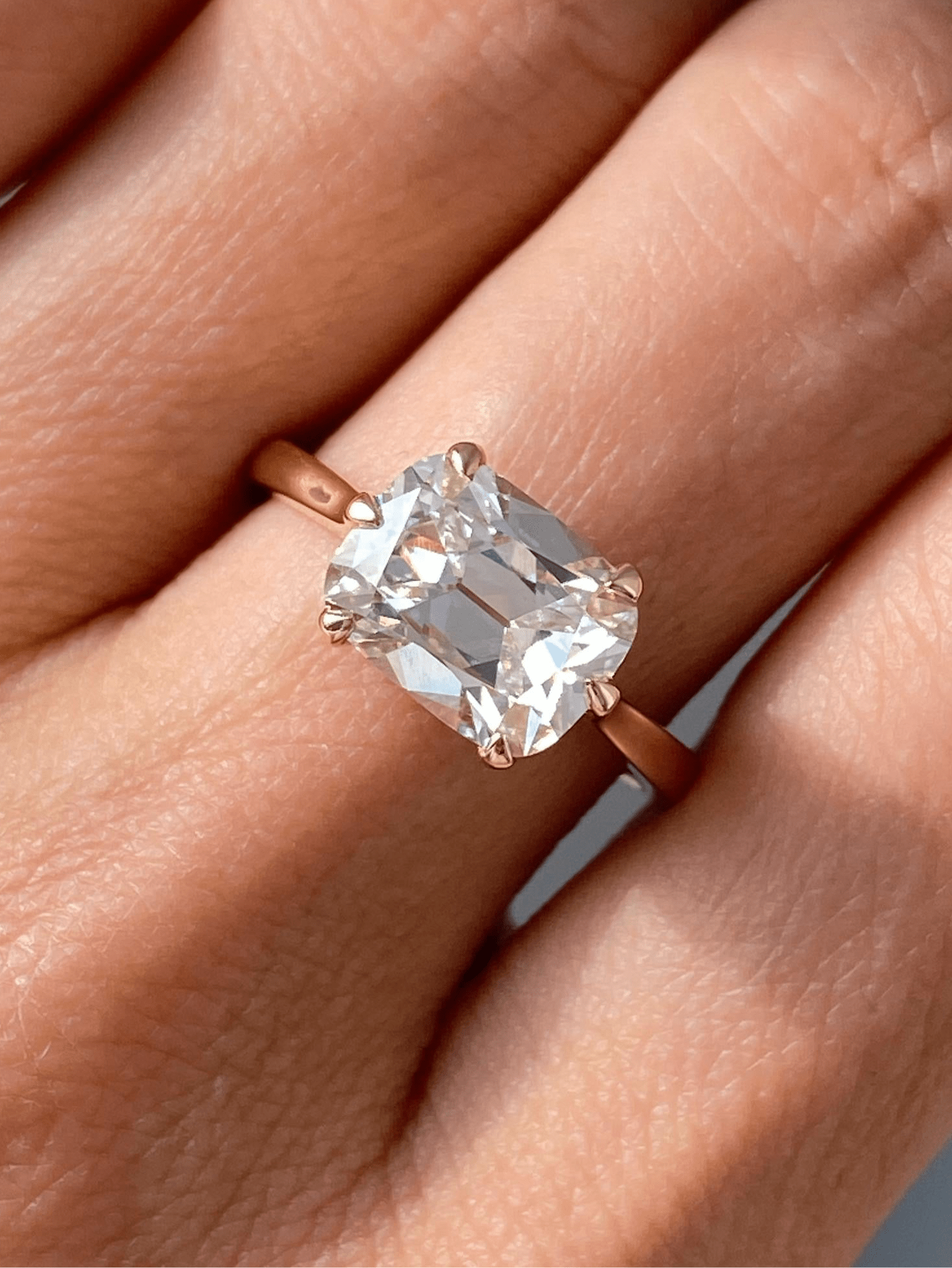
The JbC Diamond Dictionary: A Masterclass in Antique Soul
Modern diamonds are cut by lasers to be perfect. JBC diamonds are cut to have a pulse. Before the era of high-tech precision, diamond cutters used their eyes and the flicker of candlelight to find a stone’s "fire."
Here is how to identify and choose the cut that speaks to your architectural style.
1. The Old Mine Cut (OMC)
The "Architectural Cushion"
-
The Era: 1700s – Late 1800s (Georgian & Victorian)
-
The Silhouette: A soft, squarish "cushion" with rounded corners.
-
The Look: Known for its high crown and small table (the top flat surface). OMCs feature "chunky" facets that create broad flashes of light rather than tiny sparkles.
-
The Signature: Look for the open culet—a small, flat facet at the very bottom of the stone that appears as a soft circle in the center.
-
Best For: The Cleo Duo or OMC Studs. It’s the ultimate choice for someone who wants a bold, structural presence.
2. The Old European Cut (OEC)
The "Floral Round"
-
The Era: Late 1800s – 1930s (Edwardian & Art Deco)
-
The Silhouette: Round, but with a hand-carved feel that isn’t "perfectly" circular.
-
The Look: The precursor to the modern round brilliant. It shares the high crown of the OMC but applies it to a circular shape. It emits a warm, romantic glow.
-
The Signature: A "inner petal" facet pattern that looks like a blooming rose when viewed from the top.
-
Best For: The Cleo Mosaic Band. It provides a softer, feminine contrast to the sharp lines of a bezel.
3. The Rose Cut
The "Petal of Light"
-
The Era: Dating back to the 1500s (Pre-Georgian)
-
The Silhouette: Flat on the bottom, domed on the top.
-
The Look: Because it has no "basement" (pavilion), the rose cut sits low and flat against the skin. It doesn't "sparkle" in the traditional sense; it shimmers like water.
-
The Signature: Triangular facets that meet at a point in the center, mimicking the spiral of a rosebud.
-
Best For: Minimalist pendants or low-profile "second skin" rings. It’s the "quietest" of the luxury cuts.
4. The Step Cuts (Antique Asscher & Emerald)
The "Hall of Mirrors"
-
The Era: 1920s – 1930s (Art Deco)
-
The Silhouette: Rectangular or square with cropped corners.
-
The Look: Unlike the "brilliant" cuts above, step cuts feature parallel facets. They don't hide inclusions; they celebrate clarity and depth.
-
The Signature: A "staircase" effect that draws the eye deep into the center of the diamond.
-
Best For: Bold, geometric statement rings. It is the most "architectural" of all the cuts.
Comparison at a Glance
| Feature | Old Mine Cut (OMC) | Old European Cut (OEC) | Modern Brilliant |
| Shape | Squarish / Cushion | Round-ish | Perfectly Round |
| Light Play | Broad "Fire" (Colors) | Romantic Glow | White "Brilliance" (Sparkle) |
| Culet | Large & Visible | Small to Medium | Pointed / Invisible |
| Vibe | Bold & Structural | Soft & Floral | Sharp & Precise |
Why These Cuts Are Trending in 2026
The "Taylor Swift Effect" and a global move toward "Slow Luxury" have made antique cuts the most sought-after silhouettes this year. In a world of mass production, an OMC or OEC diamond feels like a thumbprint—no two are exactly alike. Whether you choose a natural heirloom or a lab-grown masterpiece, you are choosing a cut that was designed to be beautiful by the human eye, not a computer algorithm.